
Модель глубокого обучения на основе блокчейна для интеллектуальной образовательной среды
Модель глубокого обучения на основе блокчейна для интеллектуальной образовательной среды

Аннотация
В данном исследовании предлагается децентрализованная модель на основе блокчейна, обеспечивающая безопасный, масштабируемый и прозрачный обмен образовательными ресурсами и их монетизацию. Данная модель использует технологию блокчейна для обеспечения постоянства, отслеживаемости и прозрачности данных, а смарт-контракты автоматизируют ключевые процессы, такие как контроль доступа, лицензирование, осуществление платежей и распределение прибыли. Для решения проблем масштабируемости, связанных с управлением обширными образовательными ресурсами, в модель интегрированы решения распределенного хранения, которые позволяют эффективно управлять данными вне сети, сохраняя при этом целостность и возможность проверки данных в сети. Кроме того, в систему включена экономическая модель на основе токенов для поддержки различных стратегий монетизации, включая доступ с оплатой за использование, услуги по подписке и автоматизированные механизмы распределения доходов. Введены математические формулировки для моделирования и проверки процессов генерации доходов, распределения стимулов и распределения роялти в рамках предлагаемой экосистемы. Инфраструктура также усиливает безопасность за счет криптографического хеширования, механизмов шифрования, децентрализованного управления идентификацией и безопасных процедур верификации. Исходя из теоретического анализа, принципов проектирования блокчейна и свидетельств из литературы, ожидается, что предлагаемая инфраструктура повысит уровень доверия, безопасности, прозрачности и операционной эффективности по сравнению с традиционными централизованными образовательными платформами. Благодаря интеграции децентрализованного управления, безопасного управления ресурсами и участия, стимулируемого механизмами мотивации, данная структура обеспечивает масштабируемую и прозрачную основу для экосистем цифрового обучения нового поколения.
1. Introduction
The rapid digital transformation of education has accelerated the adoption of online learning platforms and Open Educational Resources (OER), fundamentally reshaping how knowledge is created, accessed, and shared
. OER initiatives have improved accessibility, reduced the cost of educational materials, and promoted collaborative learning across global academic communities , . Platforms such as OER Commons exemplify this transition toward open and distributed knowledge ecosystems. Despite these advantages, OER systems continue to face challenges related to sustainability, trust, and governance in digital environments. Most educational resource-sharing platforms still operate under centralized architectures, which introduce several structural limitations . These systems rely heavily on intermediaries for content validation and access control, resulting in reduced transparency and lower user trust . In addition, centralized systems are vulnerable to data breaches, unauthorized access, and single points of failure that may compromise sensitive educational information. Challenges related to copyright protection and intellectual property ownership also persist, discouraging educators from contributing high-quality materials due to concerns about misuse and inadequate attribution .Recent studies indicate that these challenges are closely linked to the design of centralized educational infrastructures. Research on blockchain-based educational data management shows that traditional systems suffer from inefficiencies such as data tampering risks, high verification costs, and limited interoperability
. Similarly, global studies report that educational institutions continue to face problems including credential fraud, lack of data sovereignty, and inefficient record management, which reduce the effectiveness of digital learning ecosystems . Blockchain technology has emerged as a promising solution to these issues. As a decentralized and immutable distributed ledger, blockchain enhances data integrity, transparency, and security through cryptographic mechanisms . In the education sector, blockchain has been recognized for improving the security, efficiency, and transparency of academic systems, particularly in data sharing and credential verification . Furthermore, blockchain enables decentralized learning platforms that support peer-to-peer knowledge exchange without reliance on centralized authorities, thereby promoting collaboration and inclusivity .Recent literature further highlights blockchain’s transformative potential in education. Comprehensive reviews indicate that blockchain supports the development of secure, paperless, and decentralized educational infrastructures that contribute to sustainable digital transformation
, . Governance-focused studies also suggest that blockchain can redefine trust mechanisms in education by enabling transparent and verifiable interactions among stakeholders . Despite these advancements, current blockchain applications in education remain limited in scope. Most implementations primarily focus on credential verification and certification systems, with limited attention given to secure resource sharing and monetization frameworks . In addition, there is a lack of integrated models that combine trust management, intellectual property protection, secure data exchange, and incentive mechanisms within a unified decentralized architecture , . To address this research gap, this paper proposes a decentralized blockchain framework for secure educational resource sharing and monetization.Existing blockchain-based educational frameworks mainly focus on isolated functions such as credential verification, certificate authentication, and secure content storage
. However, most studies do not address integrated educational resource management involving decentralized storage, monetization, automated governance, and royalty distribution within a unified system. The proposed framework addresses these limitations by integrating blockchain technology, smart contracts, distributed storage, and token-based incentives into a unified architecture for secure educational resource sharing and monetization , , . Table 1 presents a comparative summary of existing blockchain-based educational studies and their associated limitations, highlighting the research gap addressed by the proposed framework.Comparative Analysis of Existing Blockchain-Based Educational Studies
Study | Focus | Limitation |
Pankaj Gupta (2025) | Blockchain adoption and applications in education | Limited focus on monetization and revenue-sharing mechanisms |
International Telecommunication Union (2024). | Digital technologies and blockchain for sustainable development | No education-specific technical implementation framework |
Yogesh K. Dwivedi et al. (2023) | Blockchain and metaverse integration in education | Limited emphasis on incentive and monetization mechanisms |
Khalid Arar (2026). | Blockchain-enabled educational governance | Focuses mainly on governance without decentralized storage integration |
Gaurav Tripathi et al. (2023). | Blockchain principles, architecture, and challenges | Limited focus on educational resource monetization |
Proposed Study | Secure educational resource sharing and monetization | Integrated framework combining blockchain, decentralized storage, smart contracts, and transparent revenue sharing |
The comparative analysis indicates that existing blockchain-based educational studies mainly emphasize credential verification, governance, or general blockchain adoption. However, limited attention has been given to integrated educational resource monetization, decentralized storage scalability, and automated royalty distribution. The proposed framework addresses these gaps by combining secure sharing, smart-contract automation, distributed storage, and token-based incentives within a unified architecture.
1.1. Research Contributions and Novelty
While blockchain technology, InterPlanetary File System (IPFS), smart contracts, and token-based incentive mechanisms have been individually investigated in previous studies. According to
, , also limited research has explored their integrated application within a unified framework specifically designed for educational resource sharing, ownership protection, and content monetization. This study addresses this gap by proposing a comprehensive blockchain-enabled educational ecosystem that combines decentralized storage, automated royalty management, and incentive-driven participation.The primary contributions of this study are as follows:
1. Integrated Educational Resource-Sharing Architecture. This study proposes a multi-layer blockchain architecture that integrates educational content providers, learners, institutions, decentralized storage systems, smart contracts, and token-based transactions within a unified platform
. Unlike existing solutions that focus primarily on credential verification or content storage, the proposed framework supports the complete lifecycle of educational resource creation, distribution, access, and management.2. Educational Content Monetization Mechanism. The framework introduces a token-enabled monetization model that allows educators, researchers, and content creators to receive compensation for sharing high-quality educational resources. This mechanism promotes sustainable content development while encouraging broader participation within digital learning ecosystems.
3. Automated Royalty Distribution Model. The proposed framework employs smartcontracts to automatically calculate and distribute royalties whenever educational resources are accessed, purchased, licensed, or reused. This eliminates manual payment processing, improves transparency, and ensures fair compensation for content creators.
4. Educational-Sector-Specific Blockchain Governance Workflow. The framework incorporates governance procedures tailored to educational environments, including content validation, institutional approval, ownership verification, access control, dispute resolution, and transaction auditing. These governance mechanisms address challenges unique to educational resource management and stakeholder collaboration.
5. Theoretical Evaluation of Security, Transparency, and Trust. The study further provides a theoretical assessment of the proposed framework's ability to enhance transparency, data integrity, ownership protection, traceability, and trust among educational stakeholders through decentralized blockchain mechanisms.
2. Related Work
The education sector has undergone significant digital transformation in recent years, leading to increased reliance on electronic records, online learning platforms, and digital credential management systems
, . While these technologies have improved accessibility and operational efficiency, concerns regarding data security, certificate forgery, record manipulation, and trustworthiness remain prevalent. Blockchain technology has emerged as a promising solution to address these challenges by providing a decentralized, transparent, and tamper-resistant environment for managing educational data . This section reviews existing studies related to blockchain technology in education, smart contracts for educational record management, existing blockchain-based educational frameworks, and identifies research gaps that motivate the proposed framework.2.1. Blockchain Technology in Educational Systems
Blockchain is a decentralized distributed ledger technology that records transactions across multiple nodes in a secure and immutable manner. Unlike traditional centralized databases, blockchain ensures that stored information cannot be altered without network consensus, thereby enhancing data integrity and security. In educational environments, blockchain technology has attracted considerable attention due to its potential to securely manage academic records, student credentials, transcripts, and certificates. According to Alwakid , educational institutions can leverage blockchain to create permanent and verifiable records that are accessible to authorized stakeholders while preventing unauthorized modifications. Several researchers have highlighted the benefits of blockchain in education, including enhanced security, transparency, accountability, and trust. The decentralized nature of blockchain reduces dependence on a single authority and minimizes risks associated with data breaches and record tampering. Selvi and Vishnu Priya proposed a blockchain-based document verification framework for educational institutions. Furthermore, blockchain enables efficient verification of academic credentials, reducing administrative burdens and verification delays. Despite these advantages, challenges such as scalability, privacy concerns, interoperability, and implementation costs continue to influence the adoption of blockchain technologies within educational institutions.
2.2. Blockchain Applications in Education
Blockchain technology has been applied in various educational contexts, including student record management, digital certificates, academic credential verification, learning achievement tracking, and lifelong learning portfolios. One of the most widely explored applications is digital credential management. Traditional certificate verification processes are often time-consuming and susceptible to forgery. Blockchain-based systems provide immutable digital certificates that can be independently verified by employers, universities, and professional organizations without relying on manual verification procedures. Researchers have also proposed blockchain-enabled systems for managing student transcripts and academic achievements
. These systems allow students to maintain ownership of their educational records while granting controlled access to authorized parties. Such approaches improve transparency and facilitate seamless sharing of academic information across institutions. In addition, blockchain has been integrated into e-learning environments to support secure assessment management, certification processes, and learner achievement tracking . These applications demonstrate the potential of blockchain to transform educational administration and enhance trust among stakeholders.
2.3. Smart Contracts for Academic Credential Management
Smart contracts are self-executing programs deployed on blockchain platforms that automatically perform predefined actions when specified conditions are satisfied. In educational systems, smart contracts can automate numerous administrative processes, reduce operational costs and minimize human intervention
. For example, smart contracts can automatically issue digital certificates upon successful completion of academic requirements. Once predefined criteria are met, the smart contract records the achievement on the blockchain and generates a verifiable digital credential. This automation reduces administrative delays while ensuring consistency and accuracy. Smart contracts can also facilitate academic record sharing and access control . Educational institutions may define rules governing who can access specific records and under what conditions. Such mechanisms enhance privacy and provide greater control over sensitive educational information. Furthermore, smart contracts contribute to trust and transparency by ensuring that all actions are executed according to predefined rules that cannot be altered arbitrarily . Consequently, stakeholders can confidently rely on the authenticity and integrity of educational records stored within the blockchain network.
2.4. Existing Blockchain-Based Educational Frameworks
Numerous blockchain-based educational frameworks have been proposed to address challenges associated with credential verification, record management, and academic data security
. Several studies have developed blockchain systems for issuing and verifying digital certificates . These frameworks typically enable educational institutions to publish credentials on a blockchain network while allowing employers and other stakeholders to verify certificate authenticity without contacting the issuing institution . Other researchers have proposed decentralized student record management systems that provide students with lifelong ownership of their academic achievements. Such systems facilitate interoperability among educational institutions and support secure transfer of academic records across different learning environments .Recent studies have also explored integrating blockchain with emerging technologies such as cloud computing, artificial intelligence, and the Internet of Things to create intelligent educational ecosystems
. While these frameworks demonstrate significant potential, many remain limited by scalability challenges, privacy concerns, implementation complexity, and lack of comprehensive trust evaluation mechanisms.
2.5. Research Gap and Motivation
The reviewed literature demonstrates that blockchain technology has been widely applied in educational environments for credential verification, certificate authentication, transcript management, and secure academic record storage
, . Many existing studies focus on ensuring the authenticity of educational credentials and reducing certificate fraud through decentralized verification mechanisms.However, limited attention has been given to educational resource sharing, creator compensation, content monetization, and governance mechanisms that support sustainable knowledge exchange
. Existing frameworks generally treat educational content as static records rather than digital assets that can be securely distributed, licensed, monetized, and reused within a decentralized ecosystem. To highlight this distinction, Table 2 compares the primary focus of existing blockchain-based educational systems with the contributions of the proposed framework.Comparison Between Existing Studies and the Proposed Framework
Feature | Existing Studies | Proposed Framework |
Certificate Verification | ✓ | ✓ |
Academic Record Management | ✓ | ✓ |
Credential Authentication | ✓ | ✓ |
Educational Resource Sharing | Limited | ✓ |
Educational Content Monetization | Rare | ✓ |
Automated Royalty Distribution | Rare | ✓ |
Token-Based Incentive Mechanism | Limited | ✓ |
Decentralized Educational Marketplace | Rare | ✓ |
Educational Governance Workflow | Limited | ✓ |
Integrated Educational Ecosystem | Limited | ✓ |
Based on the identified gaps, this study proposes a blockchain-enabled educational ecosystem that extends beyond credential verification and record management
. The framework integrates educational resource sharing, tokenized content monetization, automated royalty distribution, decentralized governance, and smart-contract-based transaction management into a unified architecture . These capabilities distinguish the proposed framework from many existing blockchain applications in education and provide a foundation for sustainable decentralized academic content exchange.3. Framework Design and Theoretical Evaluation
This section presents the proposed blockchain-based framework for secure and transparent agricultural supply chain management
. It describes the overall system architecture, including the participating stakeholders, blockchain infrastructure, smart contract mechanisms, and data flow processes , . The section further explains how the framework addresses key challenges such as traceability, data integrity, trust, and transparency , . A theoretical evaluation is conducted by analyzing the framework against established security, scalability, and operational requirements to demonstrate its potential effectiveness in real-world agricultural supply chains.
3.1. Proposed System Architecture
The proposed architecture employs a layered, decentralized architecture for secure and transparent educational resource sharing
, . Blockchain technology provides immutable record-keeping and transaction verification. Smart contracts automate payments and access control. Distributed storage systems such as IPFS improve scalability by storing large educational resources off-chain . The user layer supports interactions among educators, learners, and institutions. In addition, the token economy enables secure transactions and incentivizes participation.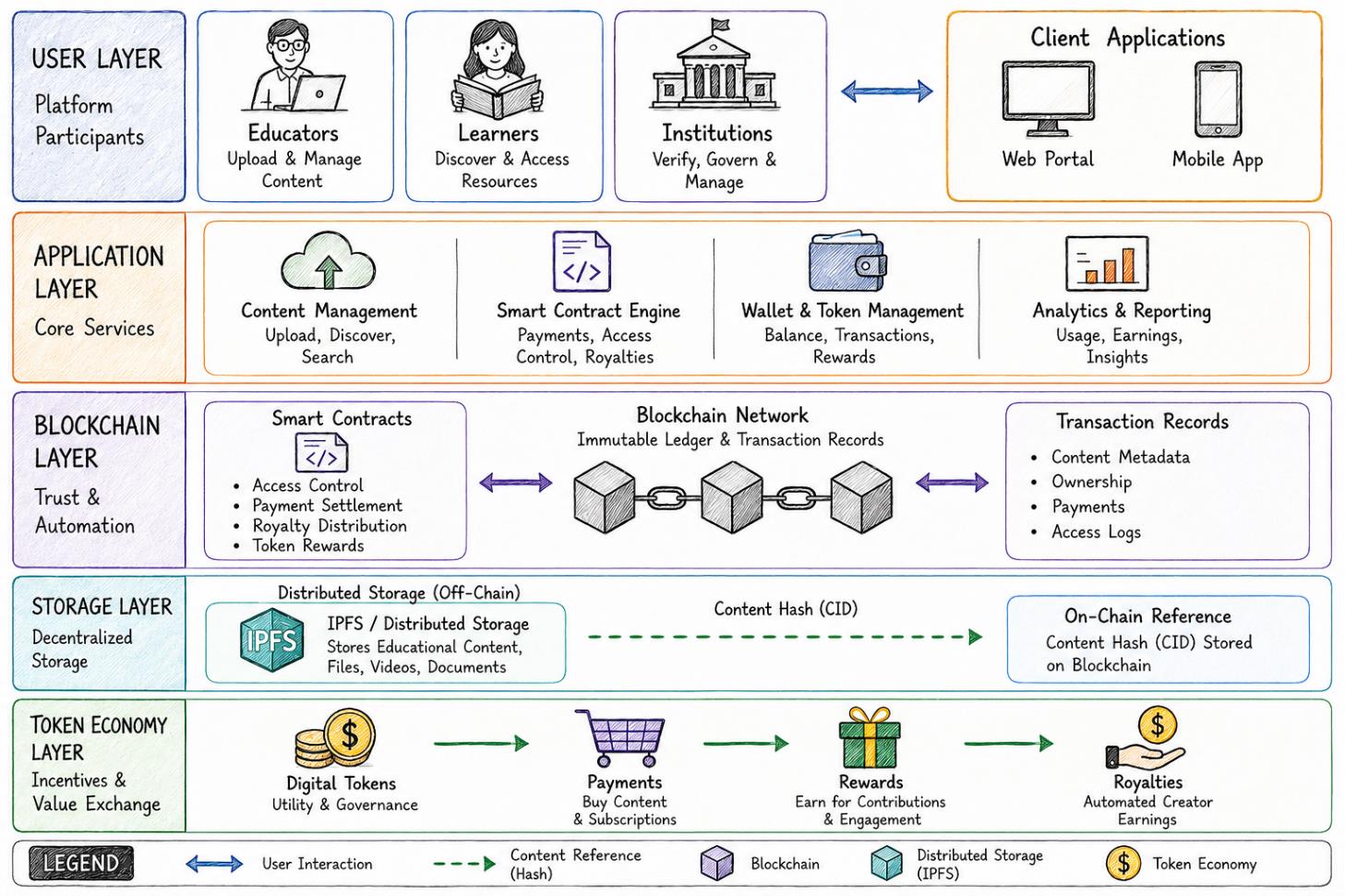
Proposed Multi-Layer Blockchain Architecture for Educational Resource Sharing and Monetization
The Blockchain Layer forms the core of the framework by maintaining immutable transaction records, executing smart contracts, and ensuring transparency and trust among participants. The Storage Layer manages educational resources and metadata using distributed storage mechanisms, thereby reducing dependence on centralized repositories while enhancing data availability and integrity. The Token Economy Layer introduces incentive mechanisms that reward users for contributing, sharing, reviewing, and utilizing educational resources. Through token-based transactions, the framework encourages active participation and sustainable resource exchange within the educational ecosystem. Together, these layers provide a secure, transparent, and decentralized environment for educational content management and value exchange.
3.2. System Workflow
The system workflow begins with an educator uploading a resource, which is hashed and stored in distributed storage (e.g., IPFS), while its metadata is recorded on the blockchain
, . A smart contract defines pricing and access rules. When a learner requests access, payment is made using digital tokens, and upon verification, the smart contract automatically grants secure access.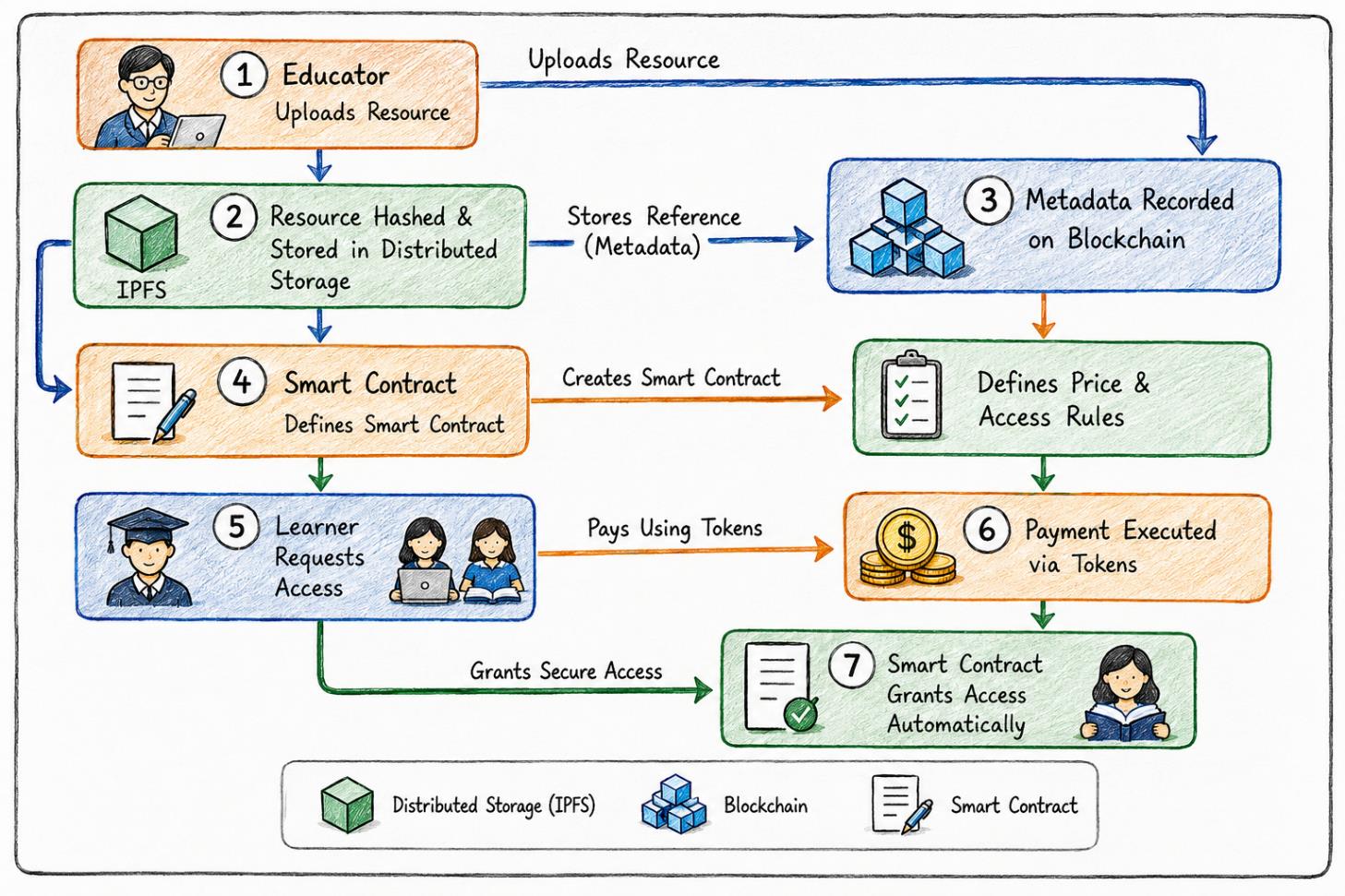
System workflow architecture components illustrating the key processes and interactions within the proposed platform
3.2.1. Operational Workflow and Transaction Sequence
The operational workflow begins when an educator uploads educational content to distributed storage such as IPFS
, . A cryptographic hash of the content is generated and stored on the blockchain together with ownership and pricing metadata . A smart contract is then deployed to manage access permissions and transaction rules. When a learner requests access, payment is submitted using digital tokens . After blockchain verification, the smart contract grants secure access and records the transaction immutably , . The framework also supports automatic royalty distribution to content creators. In addition, cryptographic verification ensures data integrity and detects unauthorized modifications.3.3. Security Mechanism
The proposed framework incorporates a robust token-based economy designed to ensure fair compensation, transparency, and sustainability within the educational ecosystem
. It supports multiple monetization strategies, including a pay-per-use model where learners pay only for the resources they access and subscription-based access, which enables continuous learning through bundled content offerings , . Additionally, the system facilitates automated royalty distribution, ensuring that content creators receive fair and traceable earnings for their contributions. The platform also enables peer-to-peer transactions, eliminating intermediaries and reducing transaction costs. From a mathematical perspective, the total earnings of a content creator can be modeled as:Where:
E = total earnings;
S = subscription pool;
α = proportional share.
Equation (2) ensures fair and automated revenue distribution among content creators according to their contribution levels. The proportional share can be determined using predefined smart-contract rules stored on the blockchain.
Monetization Models in Blockchain-Based Educational Systems
Model | Description | Advantages | Limitations |
Pay-Per-Use | Users pay per resource accessed | Flexible, user-friendly | Unpredictable revenue |
Subscription-Based | Periodic payment for access | Stable income stream | May limit occasional users |
Token-Based Economy | Uses digital tokens for transactions | Decentralized, transparent | Token volatility |
Royalty Distribution | Earnings are shared among contributors | Fair compensation | Requires accurate tracking |
Freemium Model | Basic access is free, and premium is paid | Attracts more users | Limited revenue from free users |
Licensing Model | Content licensed under smart contracts | Strong IP protection | Complex implementation |
Table 2 presents a summary of key monetization models used in blockchain-based educational systems. These models include pay-per-use, subscription-based, token-based, royalty distribution, freemium, and licensing approaches, each offering distinct advantages in flexibility, fairness, and revenue generation, while presenting limitations such as complexity, revenue uncertainty, or user accessibility constraints.
3.4. Security Features
The proposed framework incorporates several security mechanisms to protect educational resources and user data. Blockchain records ensure data integrity and prevent unauthorized modification of transactions and metadata
. Cryptographic identity verification enables secure authentication and access control. Encryption techniques protect sensitive information during storage and transmission. In addition, blockchain-based ownership records improve copyright protection and content traceability , . From a mathematical perspective, data integrity is ensured using cryptographic hash functions:Where:
D = original educational resource;
H = hash value;
h(⋅) = cryptographic hash function.
Equation (3) guarantees that any modification of educational content results in a completely different hash value, enabling immediate detection of unauthorized alterations. Authentication mechanisms rely on public-key cryptography, which can be expressed as:
Where:
M = original message;
C = encrypted ciphertext;
Kpub = public key.
Privacy protection through encryption can be further represented as:
Where:
D = sensitive data;
K = encryption key;
C = encrypted data.
Equations (4) and (5) ensure confidentiality and secure communication among participants within the decentralized educational ecosystem. Finally, distributed consensus ensures trust across the network and can be abstractly expressed as:
Where:
B = candidate block;
Vi(B) = validation vote of node i;
N = total validating nodes.
Equation (6) represents the aggregation of validation votes required to approve and append a block to the blockchain ledger.
3.4.1. Cryptographic Security Mechanisms
The proposed framework integrates cryptographic mechanisms to ensure data integrity, confidentiality, and authentication
, . It also secures the distribution of rewards within the decentralized educational ecosystem. Blockchain hashing techniques are used to verify the integrity of educational resources uploaded to the distributed storage layer. The hash generation process can be mathematically represented as:Where:
D = educational resource data;
H = blockchain hash value.
This mechanism ensures that any modification to educational content generates a different hash value, making tampering immediately detectable. The encryption process is represented as:
while the decryption process is expressed as:
Where:
M = original message or educational data
C = encrypted ciphertext;
Kpub = public key;
Kpriv = private key.
These mechanisms ensure secure data transmission, confidentiality, authentication, and non-repudiation across the decentralized blockchain network.
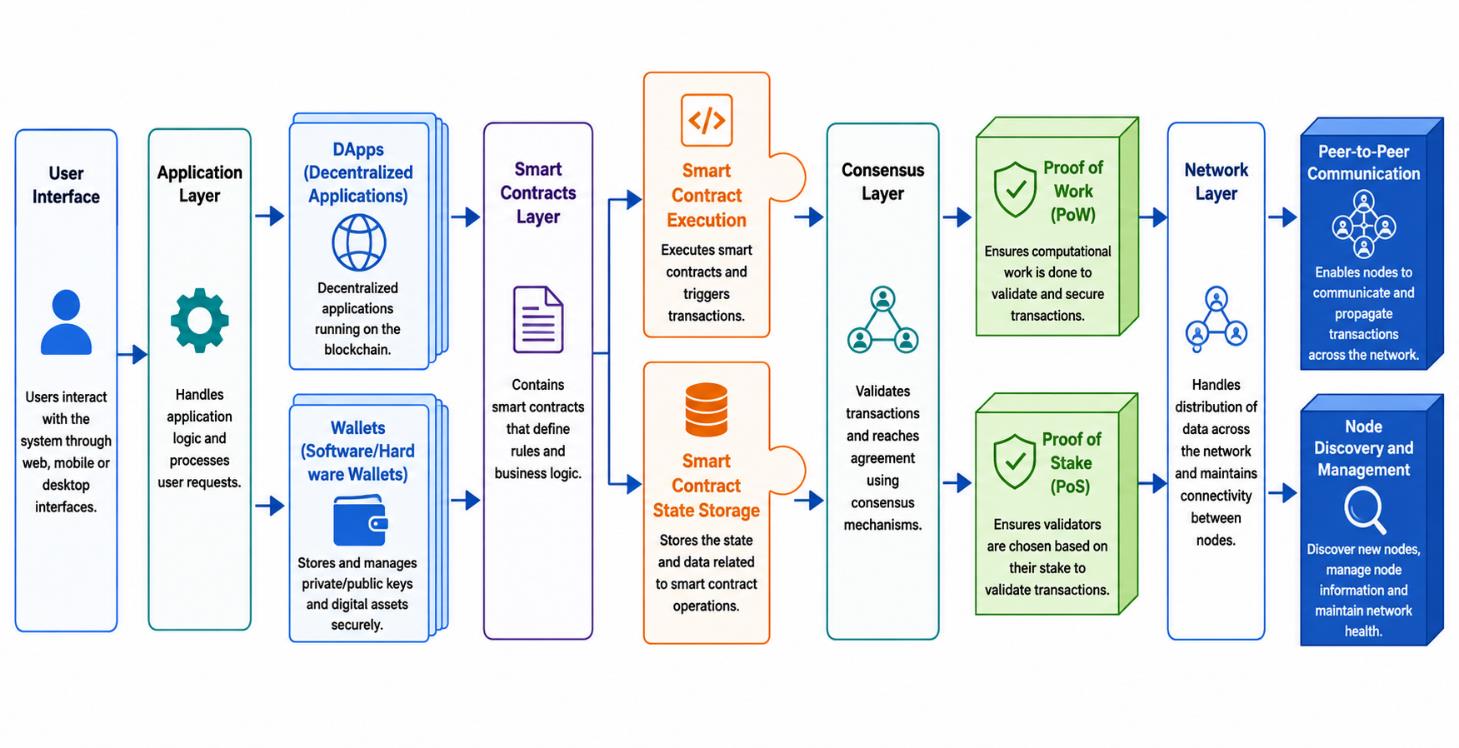
Secured layer features illustrate the core security mechanisms, including data integrity, authentication, encryption, and consensus processes
3.5. Use Cases
The proposed blockchain-based framework supports secure, transparent, and decentralized management of educational resources in higher learning institutions
. The following use cases illustrate how the framework can be applied in real-world academic and learning environments.
3.5.1. Universities
The framework enables universities and other higher learning institutions to securely share lecture materials and research publications
, . It also includes academic records and other digital educational resources through blockchain-backed verification and decentralized storage mechanisms . By leveraging cryptographic hashing and immutable ledger technologies, the system ensures that shared content remains authentic, tamper-resistant, and traceable throughout its lifecycle . This enhances trust among collaborating institutions while reducing risks associated with unauthorized modification, duplication, or loss of academic materials , . In addition, the framework promotes cross-institutional collaboration by enabling universities to exchange educational resources, jointly develop online courses, and participate in collaborative research and training programs within a trusted digital environment , . Academic credentials, certifications, and learning records can also be securely verified and shared among institutions without dependence on centralized intermediaries, thereby improving interoperability, transparency, and administrative efficiency in higher education ecosystems , .
3.5.2. Online Learning Platforms
For e-learning providers, the proposed system enables efficient and secure course monetization through blockchain-supported token-based payments
. It also offers subscription services and decentralized transaction processing. Learners can access digital educational resources through transparent payment mechanisms that reduce reliance on intermediaries and improve transaction traceability and accountability . Furthermore, the framework supports automated, transparent revenue distribution via smart contracts, ensuring that instructors . However, researchers and content creators receive fair compensation in accordance with predefined contractual terms. This automated process minimizes payment disputes, reduces administrative overhead, and eliminates delays associated with traditional payment systems, thereby promoting trust and sustainability within digital learning ecosystems .
3.5.3. Research Communities
The platform enables researchers and academic institutions to securely share datasets and publications
, . It also involves experimental findings through blockchain-based infrastructure while ensuring data authenticity, integrity, and traceability , . It also supports immutable attribution tracking by recording authorship and contributions. However, ownership rights on the blockchain enhance transparency, protect intellectual property, reduce the risk of plagiarism, and promote secure research collaboration .
3.6. Advantages of the Proposed Framework
The proposed framework adopts a decentralized trust model, eliminating reliance on central authorities while ensuring reliability through distributed consensus
. The system promotes transparent and verifiable transactions, allowing all activities to be securely recorded and audited on the blockchain . Through smart contracts, payments and access control are fully automated, reducing delays and minimizing human intervention. Additionally, the framework fosters incentivized knowledge sharing by rewarding contributors with digital tokens, thereby encouraging active participation and content creation. It also reduces operational costs by eliminating intermediaries and streamlining processes , . Overall, these advantages contribute to a more secure, efficient, and equitable digital learning ecosystem.
3.7. Challenges and Limitations
Despite the potential benefits of blockchain-enabled educational systems, several practical challenges may hinder large-scale adoption in higher learning institutions
, . First, limited internet infrastructure in developing regions may affect the reliability and accessibility of distributed blockchain services . Second, blockchain transaction costs, particularly in public blockchain networks, may increase operational expenses during high-volume transactions. Third, resistance to user adoption among educators, students, and institutional administrators may slow implementation due to limited technical awareness and concerns about change management , . In addition, legal and regulatory uncertainty surrounding token-based incentive mechanisms and digital asset governance remains a significant challenge in many jurisdictions. Furthermore, integrating blockchain platforms with existing Learning Management Systems (LMS) and institutional databases may require substantial technical modifications and interoperability support .
3.8. Framework Validation
Because this study is conceptual in nature and does not include prototype implementation or empirical experimentation, the proposed framework was evaluated through theoretical analysis, workflow assessment, and comparative examination against traditional centralized learning management systems
. The evaluation focuses on transparency, ownership verification, security, automation, and decentralization characteristics derived from blockchain design principles and findings reported in existing literature.
3.8.1. Scenario-Based Validation
In a typical use case, an educator uploads educational content to distributed storage such as the InterPlanetary File System (IPFS), where a cryptographic hash is generated and recorded on the blockchain to ensure integrity and traceability. A smart contract then defines pricing, access permissions, and royalty distribution rules. When a learner requests access, payment is processed using digital tokens, and the smart contract automatically verifies the transaction, grants access, and distributes royalties to the content creator without intermediary involvement
. The scenario-based theoretical analysis suggests that the proposed framework effectively prevents data tampering through cryptographic hashing and immutable blockchain records. Transparency is ensured through verifiable transaction histories, while ownership verification is strengthened through blockchain-based authorship tracking . Additionally, smart-contract automation improves operational efficiency by reducing manual processes, minimizing disputes, and eliminating reliance on centralized intermediaries.
3.8.2. Comparative Theoretical Analysis
Comparative Theoretical Analysis was conducted between traditional Learning Management Systems (LMS) and the proposed blockchain-based framework. The comparison focused on transparency, ownership tracking, tamper resistance, revenue automation, and dependence on intermediaries to evaluate the framework’s effectiveness in improving security, trust, and operational efficiency in educational resource-sharing systems.
Comparative Validation of Traditional Learning Management Systems (LMS) and Proposed Blockchain Framework
Feature | Learning Management Systems (LMS) | Proposed Blockchain Framework |
Ownership Tracking | Weak | Strong |
Transparency | Limited | Full |
Revenue Automation | Manual | Smart-contract based |
Tamper Resistance | Low | High |
Intermediaries | Required | Eliminated |
Royalty Distribution | Limited | Automated |
Traceability | Partial | Immutable |
Access Verification | Centralized | Decentralized |
Content Integrity | Vulnerable | Cryptographically Secured |
Trust Mechanism | Institution-dependent | Blockchain Consensus |
The comparative theoretical analysis suggests that the proposed blockchain framework has the potential to improve transparency, traceability, trust, and automation when compared with traditional learning management systems
. These expected benefits are derived from blockchain characteristics such as immutability, decentralized consensus, smart-contract automation, and distributed storage mechanisms reported in existing studies .4. Discussion
The theoretical analysis suggests that blockchain technology can improve trust, security, transparency, and monetization in educational resource-sharing systems. By removing centralized control, the framework reduces single points of failure and enhances transparency through immutable transaction records. The token-based economic model also encourages active participation from educators and content creators. Unlike existing blockchain-based educational systems that mainly focus on credential verification, the proposed framework integrates decentralized storage, smart contracts, monetization, and royalty distribution within a unified architecture. Despite these advantages, challenges such as scalability, regulatory uncertainty, and adoption barriers remain important considerations for future research.
5. Conclusion
This paper presents a robust decentralized blockchain framework that enables trusted, verifiable, and efficient sharing and monetization of educational resources. By leveraging blockchain technology and smart contracts, the proposed framework is designed to address critical challenges such as trust, data integrity, security, and fair compensation for content creators. The proposed framework not only streamlines resource distribution but also introduces a sustainable, token-driven economic model that incentivizes participation and knowledge exchange
, . By integrating smart contracts, distributed storage, and token-based incentives, the system is intended to support fairness, scalability, and efficiency. This work provides a strong foundation for future research in decentralized digital education and emerging intelligent learning systems.